Marble Polishing:
Repair Dull Etched Marble
Marble polishing and etching are commonly misunderstood. Those dull "water spots" and "glass-rings" (etch marks) are baffling. And often people hold false assumptions and have incorrect ideas about how to polish marble or how marble polishing is actually performed to create a shiny surface finish.
Many think that the shine or polish on marble comes from applying a potion, lotion or chemical during marble cleaning.
Also, some believe that all marble is supposed to be shiny and that the dull etch marks are some type of "stain".
Well, none of the above is true, but some of it is not entirely false either, which requires some explanation... here we go!
It's not surprising there's confusion surrounding the topic of marble polishing since the term "polish" has a number of subtly different meanings in the stone industry.
Most often what is meant by "polish", "polished" or "polishing" is in reference to the type of "finish" on marble, travertine, limestone, granite or any natural stone.
Natural stone can be finished with a number of different surface types, styles or looks depending on what is wanted by the buyer.
A "polished" finish is the shiny, high-gloss type of finish with the deepest color saturation commonly seen on marble and granite countertops.
Because a polished/shiny finish is so common, many people believe that all marble is supposed to be polished or shiny.
However, as noted above, marble (or nearly any stone) can have a number of different finish types.
A "honed" finish is satin-smooth, but is not reflective or shiny and the colors are more muted. It's often referred to as a "matte" finish.
Other surface finishes include: tumbled, flamed, antiqued, brushed, hammered and more.
Each of these has a different look, however all of them are non-reflective. Only a "polished" finish has the high-gloss, shiny surface.
It is very common for marble floors to have a honed finish since it's easier to maintain. And even though colors are more muted with a hone finish, many stone colors and patterns are more appealing with a honed finish.
A shiny polished finish will wear down with foot traffic creating dull trails around the floor. Also, dust and dirt are seen much more easily on a polished floor.
Sometimes people buy a house with a honed floor and mistakenly think that something is wrong with it because it seems dull compared to the shiny marble seen in hotels, etc. They reason that it should be shiny, or it just needs "polishing" with a marble "polish". Let's clarify....
Marble Polishing Process
It's a common myth that the shine on marble countertops and floor tile is achieved by applying some type of chemical or "polish" to the surface. Not exactly.
The "shine" on marble is not something that sits on top of the marble... it is part of the marble itself.
The shiny polish seen on marble slabs, countertops, tile, and other stones is achieved by high friction on huge stone polishing machines at the factory long before it gets to a stone warehouse, showroom, or to your kitchen or bathroom countertop.
Video: Marble Polishing at the Factory
You can "enhance" that factory shine of a polished marble countertop by applying a Topical Marble Polish, but this will not create the shine. It just makes the inherent shininess really pop.
However, there is one situation (etching - see below) where a chemical compound can be used to polish marble, it utilizes as physical process (like sanding wood) to bring back the shine. The chemical itself does not supply the shine.
This specialized product is engineered to work on marble (travertine or limestone too) that was originally polished to a shine. So, it restores a damaged shiny finish, but is insufficient to create that shine from raw marble to begin with.
A certain finish can be changed or re-finished after installation, but this requires the skill of an experienced marble repair / restoration professional using special tools, abrasives and a multi-step process... not just a wipe down with a chemical or "polish".
If your marble or travertine tile floors need refinishing, you'll want to learn about recrystallization. It's an alternative method to traditional marble polishing. We do not recommend it, however, it's helpful to know why and how it works.
Long story short... creating a particular finish on marble (or any stone) or polishing marble to make and entire countertop or floor "shiny" is not a DIY job.
However, let me explain the subtle distinction that arises with the issue of etching.
Mystery of Marble Etching
Marble (travertine, limestone and any "calcitic" stone too) is sensitive and reactive with certain types of foods, products and chemicals, which can damage the surface finish leaving dull and/or lighter-colored whitish spot often described as a "water spot", "water stain", "glass-ring", or "ghost stain".
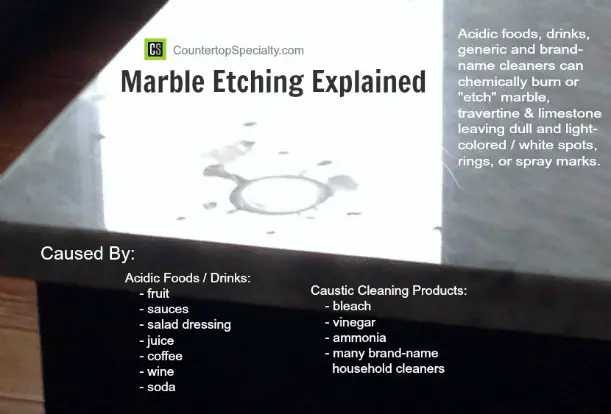
So, if you spill acidic orange juice (or any of the many other acidic foods and drinks) on marble it will corrode the surface.
This corrosive chemical reaction will essentially eliminate the shiny surface layer achieved from the marble polishing process described above revealing the dull marble underneath.
It's like a chemical burn.
If you use the wrong products for cleaning marble (too acidic or too alkaline) you can destroy the shiny finish over the entire surface making your whole marble countertop or floor "dull".
Follow our Marble Cleaning Do's & Dont's Guide and you'll avoid dullness, scratching, stains, and all other issues.
Etching begins on contact and the longer the exposure the more severe the etching.
And sealing the marble does not prevent etching. You must prevent contact with the reactive substances.
An etch mark is not a "stain". Nothing has absorbed into the marble. Also, plain water (unless acidic like some well and city water supplies) does not cause it.
Etching and staining are two completely different processes.
Learn how to diagnose marble stains.
You may hear or read that "marble stains easily".
Actually... marble does not stain easily... it "etches" easily and most (including many in the stone industry) don't know the difference.
Here's the twist about how a shiny finish is created and how marble polishing is done...
As noted above, the original finish (no matter what type) is done "at the factory" with machines or by fabricators in their shop. Applying some potion or chemical does not do it.
However... a previously factory polished marble countertop or tile that has dull spots from etching can be repaired rather easily using a nifty DIY marble polishing compound made specifically for this purpose.
Repairing Etch Marks
The method and/or product required to repair etch marks depends on the type of finish on the marble.
On shiny polished marble:
The Etch Remover Marble Polishing powder is very effective for restoring small areas of mild to moderate surface damage. It will not take raw marble and make it shiny or
"polish" it, nor is it really suitable to re-finish a honed marble so it is
polished and shiny.
It will make a honed marble shiny or more shiny, but it is not made to be used by a homeowner to re-finish a large area like a floor or entire countertop.
On honed marble:
The Marble Polishing Pads - Drill Kit will remove etch marks and restore the finish to either a honed or a polished finish. The type of finish is determined by where you stop in the process of using the various pads of this product.
Both of the above DIY products are intended and designed for easy use by an inexperienced homeowner.
You'll find our Removing Etch Marks e-book helpful with a complete discussion of marble polishing and etch removal along with step-by-step instructions for all possible situations and a DIY method for fixing etching on honed marble that does not require a product.
The same information in the above e-book along with everything else you should know about cleaning marble, protection, maintenance and the most effective solutions for all types of problems and marble cleaning issues is in the Cleaning Marble Secrets e-book.
Putting It All Together
It's easy to see why the nuances of marble polishing create such confusion and misunderstanding.
The long and short is that whatever finish you want on your marble (shiny, flat, rough, rustic) it is originally done at the factory, by a skilled professional prior to install, or as a marble repair.
Again, a finish can be changed once installed, but that is a demanding job that requires special abrasives, tools and the skill of an experienced stone restoration professional. It's not a DIY job... not even for the handiest of handymen.
Also, any finish type you find on marble (say in an existing home you purchase) is likely the original finish.
If it is "dull" or honed, then likely that's the way it is supposed to be and it doesn't "need polishing".
Although, it could have been etched by using the wrong marble cleaning products, but that's the only time it ever "needs" marble polishing.
Of course, if you'd rather have a shiny polished finish, then you can have a honed surface polished into a shine by a professional, but there is nothing "wrong" with the honed floor.
Or if the damage and etching is over a large area of flooring or an entire countertop it may be best to consult a stone restoration professional.
Score a sweet discount on marble polishing and cleaning products with your Countertop Specialty coupon code.
Marble Polishing Questions & Answers
Learn even more! Click on the links below to read detailed answers to common (and unusual) marble cleaning questions.
Polished Marble Shower Tiles Now Dull
QUESTION: We had 10" square marble shower tiles installed on the walls of our master shower 5 years ago. The color is a deep rust with white veins. …
Black Marble Polishing
QUESTION: Once you have removed scratches and etching, what do you use to shine marble and give it that high gloss, glass look?
ANSWER: …
Repair Cracking in Marble Finish
QUESTION: I have a seven-foot marble dining table the finish has long cracks.
I have lifted a piece of the finish off the table. It looks like plastic …
Onyx Vanity Top White Spots
QUESTION: I recently moved into a home with two onyx vanity tops; caramel color with swirls of off white.
I've only been here 3 months and am taking …
Marble Polishing of Honed Countertops
QUESTION: Can honed finished marble countertops be polished so that it looks glossy/shiny? I've tried many marble polishes without success.
ANSWER: …
Polishing Marble Floor Tile Dull Spots
QUESTION: I have a question about polishing marble. I have marble floor tile in the kitchen. Now it lost the shine.
The marble color is grey with …
Repair Marble Vanity Top Dullness
QUESTION: How do you restore the luster to a dull countertop?
ANSWER: Dull spots, water-spots, glass-rings, etc. on marble countertops are usually …
Polishing Marble Coffee Table
QUESTION: I would like to know the method and products used for marble polishing and cleaning a marble coffee table that is charcoal in color.
ANSWER: …
Make Honed Marble Shiny
QUESTION: I have just had my honed white Carrara marble kitchen countertop sealed.
Is there any product I can use to give a little shine ....olive …
Re-Crystallization vs. Standard Marble Polishing
QUESTION: Are you familiar with the process of marbleizing / crystallizing for marble polishing?
They've used it in Florida and Italy for over 20 …
How To Polish Marble
QUESTION: How do you polish worn white marble?
ANSWER: In general marble polishing to restore the finish on a worn surface is done solely by a marble …
Cleaning Dulled Finish of Bathroom Marble Countertop
QUESTION: The master bath marble countertop surface has been dulled, most likely from liquid drifting down from hairspray, deodorant spray, etc.
…
Cleaning Marble Overview & Recommendations