Quartz Countertop Stain
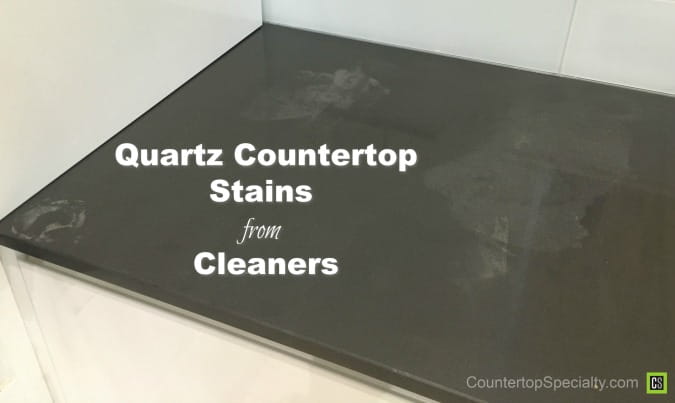
Can quartz countertops stain? Ask most homeowners and they’ll likely say, "Nope. quartz is non-porous." The reality is that stains in quartz countertops can and do occur. Especially white quartz countertops. Why? How? What can you do about it? All is answered below...
Stains in quartz countertops are different than stains in granite. That's the first point to understand at the outset.
Most homeowners are expecting quartz to be stain-
proof which is why a stain is usually a big, head-spinning surprise.
Let’s take a look at why and how that is and the best tips for preventing and removing stains in quartz countertops.
Why Does a Quartz Countertop Stain?
You’ll learn exactly why and how a quartz countertop stains just below, but first a bit of background so you understand why consumers are confused about it all.
Quartz countertops are a man-made product referred to as “engineered stone” made by blending crushed quartz and various resins, polymers, and pigments. The resulting product is truly an excellent countertop material and a top choice for kitchen countertops.
But no material is perfect. All have faults. As a consumer buying countertops, you want to clearly know all the pros & cons upfront. Not as a surprise later after you’ve spent all that money.
So, a quartz countertop is made with real stone and has properties similar to granite but the resins and other man-made elements create unique properties that are different than granite. Some good, some bad.
The resins are what help make quartz countertops non-porous (good), but the resins are also what can be damaged by cleaners, chemicals, and heat (bad).
Quartz countertop manufacturers (
Silestone,
Cambria, Caesarsone,
Zodiaq-Corian and others) all emphasize the "non-porous" nature of their product. And that’s fine. It’s true. But they let the consumer decide what that means.
BTW...
quartz vs quartzite... these are not the same.
Here’s how that usually goes…
You read that granite is porous and must be sealed to prevent stains. This is generally true (but some granites are naturally stain-resistant and don't need sealing).
Then you read that quartz is non-porous and doesn’t need sealing. Hmmm….
The natural assumption is that “non-porous” means that quartz countertops cannot be stained. After all, how can it be stained if nothing can absorb.... right?
Most people get hung up thinking it’s impossible to stain quartz counters and none of the manufacturers do much to clarify.
In their defense, no quartz brand states their surface is "stain-proof". All clearly state that quartz is "stain-resistant".
The concept is a little misleading, but it's not false.
In truth, nothing will absorb.
So, how does a quartz countertop stain if nothing will absorb?If we define "stain" as any discolored spot, then quartz will stain, but it doesn’t happen in the same way as a granite stain. The result is the same.... a stain, a spot, whatever... it looks crummy.
The mechanism of how a quartz countertop stains is different....
- A traditional stain occurs when some substance absorbs creating a dark spot.
- Quartz countertop stains occur due to a chemical reaction with the resins used to make the countertop.
- A cleaner, chemical, food or drink discolors the resin.
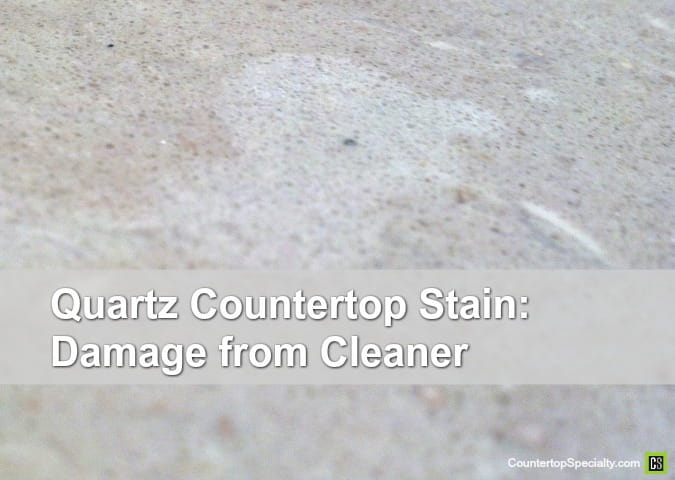
- The "stain" is usually a lighter white spot that appears bleached out (similar to marble etching)
- Nothing absorbs
- "Non-porosity" has nothing to do with it
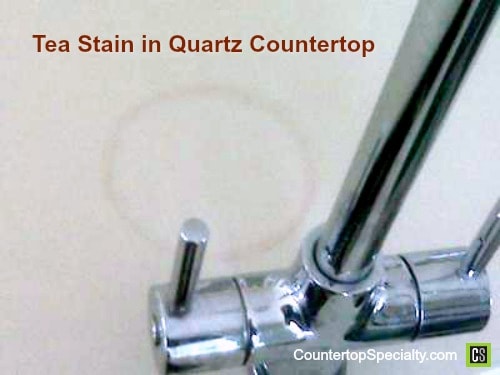
Some foods and drinks (especially tea) can result in a traditional-looking dark stain.
Still, the mechanism is likely similar. Nothing is absorbing or very minimal. The tea is likely affecting or reacting with the resin used to bind the quartz together fixing the stain on the surface.
But typically, a quartz chemical stain is white due to bleaching of the resin.
White quartz countertops are
most vulnerable to stains from food. However, all quartz colors can be damaged by chemicals or cleaners.
Quartz Countertop Stain Removal Tips
With a granite stain applying a poultice usually removes it. This technique doesn’t work for quartz countertop stains. Nothing absorbs so there is nothing to draw out. It’s not a "stain" in the traditional sense, but more like chemical damage or a bleach mark.
Quartz Stain Removal Options:
- Bar Keeper’s Friend is our favorite. It can remove many quartz countertop stains. Scrub with a nylon pad or brush. It doesn't always work since sometimes the discoloration is permanent.
Note: quartz is highly scratch-resistant, but in rare cases, abrasives can dull quartz. Test first.
Or try the non-abrasive Bon Ami (which may be less effective).
- Glass Cleaner and a non-abrasive nylon scrub pad. This can sometimes work for mild surface stains.
- Magic Eraser. Be careful and test first. It may work but also may cause further damage and dulling of the surface as it contains abrasives.
- Diluted bleach (8 parts water / 1 part bleach) can work for some spots (WARNING: see below for additional info before using bleach).
- Acetone (see more info below) can work for removing ink stains and gummy things on the surface.
Again, remember that the bleached-out stains where the resin is damaged from a chemical are likely permanent, and the above methods will not fix the spot or remove the stain. You can try but don’t hold out too much hope.
The above methods may work to remove surface stains from foods or other substances that have not damaged the resin. These are the darker spots or stains of the same color as the offending substance.
How to Remove Water Stains
Water stains are a different breed. These are from hard water buildup and leave a dull gray film.
Don't use CLR or Lime-Away as these are too acidic and will damage the resins and stain.
Regular cleaning methods won't work.
Use a
hard water cleaner safe for quartz to remove hard water stains.
It’s also great as a regular shower cleaner to remove soap scum.
Proper Cleaning & Care of Quartz Countertops
Here's some good advice on choosing an everyday quartz countertop cleaner...
To avoid damage it's best to use
cleaning products made for granite & quartz countertops. Too many common cleaners can permanently discolor quartz.
Since quartz counters are 93% quartz (a mineral in granite) it is safest to use products made for granite and stone. It won’t damage the resins.
Learn more about
cleaning and polishing quartz countertops.
Most quartz manufacturers have the same basic care and cleaning recommendations.
Quartz Countertop Maintenance Advice:
Do NOT use...
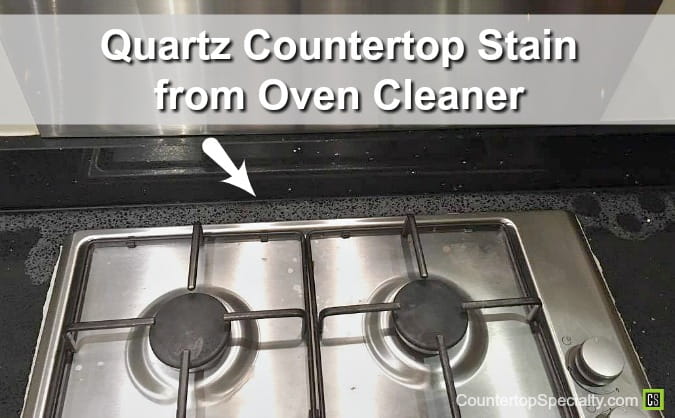
- Caustic soda, paint strippers, degreasers, oven-cleaners, are any high pH product.
- Acids like hydrofluoric acid, CLR, Lime-Away or any low pH cleaner.
- Abrasive cleaners or pads. Ironic since quartz shouldn't scratch. Note that an abrasive cleaner may be needed to remove a stain but can dull some brands of quartz. Test first.
Use with caution...
- Bleach: Do not use bleach for regular cleaning. It can be diluted to clean a specific spot, but don't leave on the surface. Rinse well.
- Acetone: Avoid prolonged contact of acetone on quartz countertops. Use only to remove a spot (like nail polish). Rinse well.
Sealing Quartz Countertops
Sealing won't prevent stains on quartz. It's a non-porous countertop material so the sealer can't absorb and isn't effective.
Also, some sealers may discolor the surface or create a haze.
Conclusion
All considered quartz is a great kitchen countertop. Very durable. So, quartz countertop stains are pretty rare but do happen.
Unfortunately, the resin gets damaged so quartz stains are often permanent.
All we can do is learn the weaknesses, take precautions, use proper care methods and cleaning products to avoid quartz countertop stains.