Marble vs. Granite Kitchen Countertop
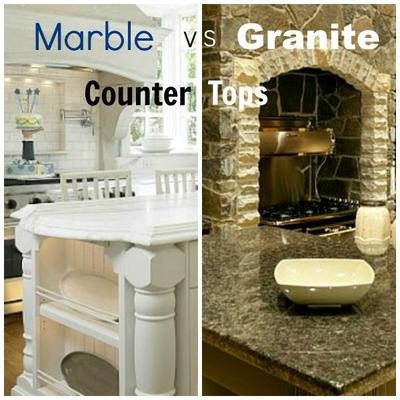

Kitchen Countertop Materials Comparison
QUESTION:
I'm in the process of making the decision on kitchen countertops.I love the look of marble, but I'm worried about the maintenance.
We currently have granite, but it's not the look I want for our remodel.
I keep hearing about staining on marble, but I want to know more about these possible stains.
- Is it only going to stain if I leave a something on the counter for a long time?
- Or is this something if it spills on the counter, I 'm getting a stain no matter what?
ANSWER:
Comparing marble vs. granite kitchen countertops is common. Many want the easy maintenance of granite countertops, but prefer the color and pattern of marble.And understandably so... marble can be absolutely gorgeous. Which is why you see plenty of photos online showcasing kitchen designs with marble countertops.
Unfortunately, a marble kitchen countertop can be difficult to maintain.
Designers don't shy away from installing it. But I fear many aren't truly aware of marble characteristics or are just sacrificing function to achieve the "look". Good design serves both needs.
Well, enough performance or functional differences exist between granite and marble to significantly impact your decision on which countertop material to install in a kitchen.
Let me explain....
Let's discuss marble countertop stains for a minute...
I know you've heard and read that marble "stains easy". However, this is not true... let me explain.
There are two types of marble "stains". One is a true stain where a substance is absorbed into the pores of the marble.
A true "stain" will make a dark spot on the marble. But true stains are not a big problem with marble. Yes, they can happen when a substance remains on the surface for an extended time, however, marble is typically not very absorbent and does not stain easy.
In fact, polished marble is nearly stain-proof (polishing closes down the pores) and usually cannot even be sealed since the sealer itself won't even absorb.
The second kind of "stain" is called "etching". It is not actually a stain, but physical damage to the marble that leaves a light and dull spot on the marble.
Etching is a corrosive reaction (like a burn) that occurs on all calcite-based stones (marble, travertine, limestone) upon contact with acidic substances like coffee, juice, soda, salad dressing, tomato sauce, vinegar, etc.
Etching also can occur upon contact with harsh alkaline cleaners like nearly all common and brand-name household cleaners available in stores, which is why you must use only products safe for cleaning marble.
The corrosive reaction eats into the marble actually destroying the marble removing the surface layer revealing the more raw marble underneath, which is more dull and lighter in color than the polished or high-honed surface.
Seems weird I know, but polishing stone brings out the color making it deeper and richer.
People often call these etch marks "water spots" or "glass rings" since they often occur from acidic drinks and leave rings.
So, people mistakenly call an etch mark a "stain" and thus arises the false reputation that marble stains easy.
Now, you may say what does it matter... stain, etch mark.
Well, etching and staining are completely different problems, but people think they understand the issue and solutions... that all you have to do is seal the surface and clean well.... not the case. Click here for more on stains vs. etching.
People understand stains... but are clueless about marble etching. This includes (unfortunately) many in the stone industry.
As noted marble staining is not much an issue and can often be made even less so by applying an impregnating sealer.
Etching cannot be prevented except by avoiding contact with acidic substances and this is IMPOSSIBLE in the kitchen no matter how cautious or how much a neat freak anyone may be.
And even if you are this person, is that how you really want to spend
Anyone who installs marble vs. granite countertops will get etch marks regularly.
Now, marble etching can be repaired rather easily on polished marble using the Marble Polishing and Etch Remover product, but it will be a constant project, and it may drive you nuts.
Many people who insist on installing a marble kitchen countertop, despite warnings against it, will opt to have the surface "honed". This finish is a more matte or some say "dull" finish compared to a shiny "polished" finish.
The advantage here is that etch marks are not nearly as visible on a honed marble countertop. Some mistakenly believe honing prevents etching. No, etching still occurs, just not as noticeable.
Why? ... because a honed surface is already a bit dull so the color is not as deep and when an acidic substance etches a honed surface the difference or contrast in color and texture of the etch mark vs. the rest of the marble countertop is not as severe or noticeable as it is with a polished surface.
So, they hone the marble countertop and seal it since a honed surface is more absorbent than a polished surface.
However, when you do get an etch mark on a honed surface that is noticeable enough to repair, the process is a bit more involved than on a polished surface.
Repairing etch marks on a polished marble countertop can be done by you or anyone using the Etch Remover Polish.
Marble etching repair on a honed countertop used to be a professional job requiring refinishing of the surface.
However, with this new Marble Polishing Pads - Drill Kit you can do it well DIY-style and avoid the expense of a pro.
So, that is the story on marble kitchen countertops...
Marble vs. Granite Kitchen Countertops
All the above is a thorough explanation of why marble countertops are not the best choice for the kitchen.
Marble kitchen flooring is fine and anywhere else in the home (except a wet bar... alcoholic drinks, sodas, juices etch) is great for marble.
I encourage people to put the marble in their bathroom instead of the kitchen.
Protection, care and cleaning of a granite countertop is sooo much easier than a marble kitchen countertop.
- Granite does not etch... (well in rare instances it can, but for all intents and purposes... it does not).
- Most granite countertops can be well-protected from staining with the easy application of a sealer like these recommended marble & granite sealers, however.....
- Many granite countertop colors don't need sealing at all, since they are naturally dense and non-absorbent.
- Granite does not scratch. It is much harder than marble. Marble kitchen countertops will get scratched.
- Granite is the most heat-tolerant of any countertop material. Virtually impossible to damage from hot pans.
A granite countertop is simply more durable and less hassle to clean and maintain than a marble countertop and that's what you want in a kitchen.
A marble bathroom countertop is rarely a problem.
Certainly, marble and granite present different looks or styles and in some instances the look is the most important element.
However, in certain areas of the home, like the kitchen countertop, function is much more important.
Even people who love wall-to-wall carpet would probably choose not to put carpet in a bathroom.... just doesn't make much sense when you have far better choices.
Given that you have 2500+ colors of granite to choose from including many granites that look like marble you should be able to find a few choices that will satisfy your style requirements without sacrificing function.
Conclusion
The whole "marble vs. granite kitchen countertop" debate gets a lot of attention. Marble is lovely, but once you consider the everyday reality of marble maintenance it's apparent that you should think twice before installing this countertop material in the kitchen.
Still some people just gotta have it. If this is you, at least now you can make an educated decision and know what you're in for instead of the frustrating surprise a marble kitchen countertop is for most people that install it based on looks alone.
Comments for Marble vs. Granite Kitchen Countertop
|
||
|
||
|
||
|
||
|
||
|
||
|
||
|
||
|
||
|
||
|
||
|
||
|
||
|
||
|
||
|
||
|
||
|
||
|
||
|
||
|
||
|
||



Excellent
Bathroom & Kitchen
Ideas
Source
2021