Sealing Marble Shower Tile & Grout
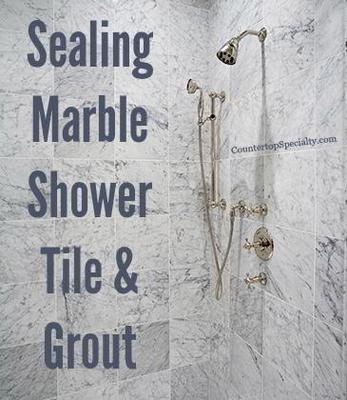

Carrara Marble Shower
QUESTION:
I just installed new marble tile in my bathroom on the shower walls and floor.Should I seal the marble tile and grout?
What is the best sealer for a marble shower?
ANSWER:
Whether or not to seal a marble shower has arguments on both sides.Some claim it's a must do while others say sealing showers doesn't really serve much purpose and may cause a problem in some cases.
Let's look at the reasons for and against and our take on it...
Do Marble Showers Need Sealing?
You may read or hear that ALL stone MUST be sealed no matter what... but that is just not true.
It depends on the stone, the location and intended use of the stone installation. For instance sealing marble kitchen countertops is usually a good idea.
Kitchens get way more traffic and abuse than bathrooms do.
On the other hand, some marbles, granites and other stones are naturally dense, stain-resistant and don't need sealing.
Problems can occur from sealing a shower. As a general rule... you don't want to apply a sealer to marble or natural stone in a shower (with one exception discussed below) or other wet environments because you run into situations where the sealer may trap water in the tile causing many problems including degradation of the stone.
Applying a sealer is done to reduce the risk of stains in marble or stone. This is very helpful in areas like the kitchen, dining room, or high-use floors or countertops in a bathroom.
The risk of staining in marble showers is near zero unless you regularly toss a salad or drink some wine in there!
Think about it... you use very few products in the shower, and when in use water is constantly washing them down the drain.
You'd have to leave a leaky bottle of something sitting on the marble tile for it to ever have a chance of staining.
Plus, marble actually is not very porous and does not stain easy.
Marble will etch easy and people always confuse etching (whitish dull spots from chemical corrosion) with staining, but these are two different marble maintenance issues.
And even if it did stain, marble stains can be removed in nearly every case.
Some people mistakenly believe that the reason to seal shower tile is to prevent the shower water from absorbing. No... also not the case (with one exception... see below).
A little water may absorb into the marble or travertine tile while showering, but it quickly evaporates and does not cause any problems. This is normal.
You don't gain any real benefit by applying a sealer since your stain risk in a marble shower is minimal. BUT... you do risk creating unwanted problems by sealing a stone in a wet environment.
In truth, the sealer itself won't "cause" a problem out of nothing, so don't worry if you've already sealed your marble shower.
However, in a case where water gets behind the tiles of a sealed shower (from cracks or voids in grout or caulk), it will block evaporation potentially making damage a lot worse.
Exception to the Rule: White Marble Showers
White marble showers are an exception to the general rule to avoid applying a sealer in wet environments.
White marble like Carrara marble, Calacatta marble and others can contain small iron deposits. Water can oxidize these deposits, which may lead to a rust stain that is difficult to remove.
This is most often a problem on floors after a flood or from a plumbing leak. Meaning the tiles and the iron deposits must be exposed to water over an extended period of time or from a continuous source.
In a shower, this could sometimes occur from water behind the tiles and not simply from water absorbed while showering.
First, marble is not that absorbent and water would have to be on the surface for quite a long time (maybe 15-30 minutes or more) before it even starts to absorb.
Honed marble tile will absorb a bit more readily, but shiny polished marble tile has a very low rate of absorption and water may not absorb
Also, since tiles are never really submerged in water in a shower, it is typically absorbed only into the surface (if at all), doesn't saturate the tile and dries quickly.
Thus, any iron deposits within the tiles (unless near the surface) are not exposed to water long enough to oxidize or rust and stains rarely occur.
Floors, benches and shelves are at greater risk for rust stains in white marble showers since water is left standing on these surfaces allowing more time to absorb and potentially oxidize embedded iron deposits.
Better safe than sorry; so, sealing white or Carrara marble shower tiles to help prevent iron oxidation is a good idea, although polished marble often can't be sealed as explained below.
What is the Best Sealer for a Marble Shower?
If you do decide to sealer your shower or if y ou have a white marble shower, then SenGuard Permanent Stone Sealer is the best sealer for the job. It can be applied to both the tile and grout.Or applying a standard quality impregnating sealer will work too but you just have to reapply it periodically.
Why is Senguard the best?
First, Senguard forms permanent bonds with the stone which means you only have to seal the marble one time. No periodic re-sealing is necessary as is required with all other sealers.
Also, its advanced technology allows for better penetration (particularly on dense, low-absorbency stones), more thorough coverage for enhanced protection against both oil and water-based stains and it's super-easy to apply.
Addition Marble Shower Sealing Tips
Poorly installed shower tile is a problem. You may have gaps, cracks or voids in the grout letting water flow behind the tiles where it gets trapped. But sealing won't help a lick in this instance... in fact, it would make it worse as noted above.
You can spot this problem as the shower tiles will start to turn gray or darker. Usually, the floor tiles are most affected but you may notice the wall tiles that touch the floor become darker as well.
What happens is the water behind the tile absorbs into the tile and darkens it. White tile like Carrara marble will look gray.
Often you'll see that half of the wall tile is gray or darker. This occurs as the water from the floor rises up inside the wall tile. Again, this is from water trapped behind the tiles.
If you decide you'd like to apply a sealer in the shower, then first perform the water test for sealing to determine if your marble could even absorb a sealer.
Sealers must absorb into the stone to work. Dense, low-absorbency stones (like polished marble) typically do not need sealing and often "cannot" be sealed because the sealer won't absorb.
Obviously, it would be absolutely useless to attempt to apply a sealer to a stone that can't absorb it and doesn't need a sealer.
Applying "just to be safe" doesn't work here. You're only looking for trouble. The result is wasted time, effort and money and a streaky sealer residue on the stone.
Waiting 2-3 weeks after shower installation is necessary before applying a sealer to allow the stone, grout and all installation materials to dry out completely or you'll trap water in the stone.
Sealing the bathroom floor is not a bad idea though. The "general rule" discussed above still applies, however, floors, benches, shelves or anywhere you may store products are at the highest risk in the shower but still pretty low-risk.
I suggest using one of these recommended marble & granite sealers.
Again, SenGuard is the best available.... head and shoulders above every other on the market. We really like this product and highly recommend it.
No need to polish marble prior to sealing unless you are repairing etch marks. Better to repair first, but you can always re-apply a sealer to any spots where etch marks were repaired.
Sweep and clean the floor tile prior to sealing. Sealers don't form a topical coating, so it won't trap dust or dirt, but you want a surface free of gunk or debris to ensure easy absorption for the sealer.
Comments for Sealing Marble Shower Tile & Grout
|
||
|
||
|
||
|
||
|
||
|
||
|
||
|
||
|
||
|
||
|
||
|
||
|
||
|
||
|
||
|
||
|
||
|
||
|
||
|
||
|
||
|
||
|
||
|
||
|
||
|
||
|
||
|
||
|
||
|
||
|
||
|
||
|
||
|
||
|
||
|
||
|
||
|
||
|
||
|
||
|
||
|
||
|
||
|
||



Excellent
Bathroom & Kitchen
Ideas
Source
2021