New Marble Floor Tile Turns Green
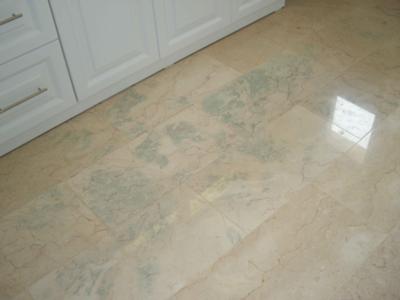

green stains after installing marble floor tiles
QUESTION:
We recently had new marble floor tiles installed.After about two months some of the marble tiles developed green stains on the surface.
This could not be removed with cleaning compounds.
Removing one tile showed that the green was in the top 1mm of the tile and not throughout the depth of the tile.
The builder used a contractor to grind the top 1mm off all the floor tiles - the grinding operation was a wet grind with a second machine removing the water slurry.
It took seven days to do all the floors in the house. Finally all the floors looked perfect.
Unfortunately, after a further two months the same green color had returned to those same tiles.
It is not all the marble tiles that are affected and only the original ones have gone green a second time.
Any advice would be appreciated. Regards, Paul Sinclair
ANSWER:
Paul, I can feel your frustration. A very puzzling problem for sure.First, you must rule out that there isn't any source of moisture underneath the marble tiles. If the sub-floor was not sealed then you could have moisture wicking up through to the marble.
Now I know you stated that the "green" is only on the top 1mm, so it would seem that it is not a moisture problem from beneath the tiles or you'd likely see evidence through the entire thickness of the tile (I agree and think this is probably not the cause).... but you need to rule it out.
My best guess is that your marble contains copper ("brown and red lines of coloration") that is being oxidized and turning green as copper does when exposed to air and moisture.
Obviously, since it's a natural product some tiles will contain more copper than others, which would explain why it's occurring only on certain tiles and the same tiles after re-surfacing.
The same type of problem can occur with white marble, which often contains iron. When exposed to moisture the iron rusts, leaches through the marble and causes brown/yellow/orange stains.
With white carrara marble and
Another reason stones turn green is when accelrants are used in adhesives to make them dry faster.
We see this mostly in marble and granite countertop installations where green spots appear on the surface shortly after installation and/or the granite slab seam edges turn green.
Such accelerants should not be used precisely because of this problem.
The green spots don't occur in all cases and sometimes the green spots will fade on their own... or can be treated (and removed) like a typical granite-marble stain.
Often though, it is a permanent problem, since the glue leached all the way through the granite countertop from underneath where the adhesive/accelerant was used... and can continue to leach through for a long time.
I don't think this is the reason for your problem with the marble floor tiles developing the green stains.
If it was due to use of an accelerant it would likely be seen over the entire floor.
Given the extent of the problem, I'd say your only good solution is total replacement. Or learn to like it.
It may have been possbile after re-surfacing to apply a topical coating or wax (not the standard impregnating sealer that is most often used on stone). A topial sealer/wax would keep air off the stone so the copper wouldn't oxidize.
However, permanent topical sealers require a lot of ongoing maintenance. They scuff and scratch and get dull. Also not good to suffocate the stone, so such topical treatments are not generally recommended for application to natural stone... especially on a floor.
I know green wasn't a color you had picked out, but honeslty it doesn't look too bad in the picture. It looks natural to the stone with a similar tone in color and not really like a stain or blemish.
I understand that it may look horrible in person, but I can't say the installer is to blame here, so if you don't want to pay for the job a second time then with lemons... make lemonade.
Comments for New Marble Floor Tile Turns Green
|
||
|
||
|
||
|
||
|
||
|
||



Excellent
Bathroom & Kitchen
Ideas
Source
2021
