Honed Marble Countertop Cleaning
QUESTION:
My bathroom and kitchen countertops are honed marble. I'm just not sure how to protect them from stains and water spots or what cleaners to use. Do I or don't I seal them? Is it different than polished marble?Do I use an abrasive pad on spots only or over the whole countertop?
I do have some spots... how do I get rid of them? Thanks!
ANSWER:
New marble owners are often confused about how to clean marble and properly protect it from stains and other damage.Certain spots can seem impossible to remove and what caused them anyway?
And the difference between polished vs. honed marble maintenance is a common question, but I got you!
Marble cleaning & maintenance is essentially the same for all marble countertops or tile, but a few key points about the differences in the surface finish are key to understand.
But yes... the type of finish (honed, tumbled, polished) can dictate whether a sealer is needed, if abrasives can be used, and which repair method is required.
Let's take a tour...
Sealing Marble Countertops
The finish type (honed marble vs. polished) definitely has a significant impact on the need (or not) for sealing.
An interesting factoid is that polished marble is less absorbent than honed.
In fact, this is true of any polished stone.
The act of polishing marble closes the pores of the stone which reduces the rate at which a particular stone will absorb a substance and potentially stain.
Marble is actually pretty dense and not very absorbent. Thus, it does NOT stain easily. And polishing the surface makes it even less so.
I know this seems to contradict what you often read about marble, however, there is a massive misunderstanding that exists in the marketplace about marble "stains" which we'll discuss below.
Suffice it to say that most polished marble does not require a sealer simply because it has such a low rate of absorption that it is naturally stain-resistant.
And just FYI... granite is different in this regard.
Polishing still closes the pores but most granite is more absorbent than marble.
So, most polished granite countertops will need sealing, although, many granite colors (especially darker colors) are super-dense and will never need sealing.
In truth, most polished marble won't even absorb a sealer so it is a futile exercise and potentially problematic.
Applying a sealer in such cases can result in a semi-permanent streaky haze. No bueno.
One important fact to note about sealing marble and all natural stone... no "one-size-fits-all" rule exists. Basic generalities yes, but each case must be considered on its own.
Some marble countertops will take a sealer even when polished, but again, many won't need sealing.
How do you know when to apply a sealer or not? Luckily, it is super-simple... just perform the water test for sealing. This test will give you a specific answer for your specific marble.
Almost always it is necessary to seal honed marble countertops and tile. You should still test, but in most cases, sealing is best especially in the kitchen where the risk of staining is high.
I'd suggest using one of these recommended impregnating sealers, which we've found provide the best performance and durability of any currently on the market.
Cleaning Honed Marble Countertops
For general cleaning, do NOT use abrasive pads on marble. Marble is dense, but soft and abrasive pads will scratch the surface.
It's particularly important on a polished finish where minor scratches are plainly visible, but also on honed finishes.
A "tumbled" marble finish can stand up to abrasive scrubbers a little better since the finish is already very rough. It will still scratch, but just not as noticeable.
Using non-abrasive pads and cleaners is best.
The most important point is to use only products safe for cleaning marble or risk damaging the surface.
At least half of all cases of marble damage that we consult with clients about are caused by using the wrong cleaning products or experimenting with homemade concoctions.
Vinegar, ammonia, and bleach are all off-limits and most common / brand-name household cleaners
Many customers wonder if specific marble cleaners are required for use on honed marble countertops vs. on polished marble.
The short answer is... no.
We get this question mainly regarding cleaners for special issues like soap scum & hard water removal.
Or for the mold & mildew cleaner.
The finish type does make a difference regarding sealing and for specific repairs (see below).
But this is not a factor when it comes to marble cleaners.
Any cleaner safe for use on marble can be used on any finish type.
Only certain marble repair products affect the finish. Marble-safe cleaners do not.
Removing Stains & Spots on Honed Marble Countertops
It is a misconception that "marble stains easily". It does not. What is does easily do is "etch" and this is where the confusion starts.
Staining and etching both create spots, but in two completely different ways.
People label any spot (including etch marks) on marble as a "stain". This is not accurate, but since marble etches easily it leads to the mistaken idea that it "stains" easily.
Why does this matter? Here's why...
Sealers help prevent stains but will not prevent etching.
The common (but mistaken) wisdom is that "marble stains easy" so it must always be sealed and often. But as we learned above, marble is dense, does not stain easy and does not require a sealer in many cases.
Certainly, marble can stain and honed marble stains more readily than a polished marble, but the risk is lower than with granite countertops.
So... you have spots on your marble. What kind?
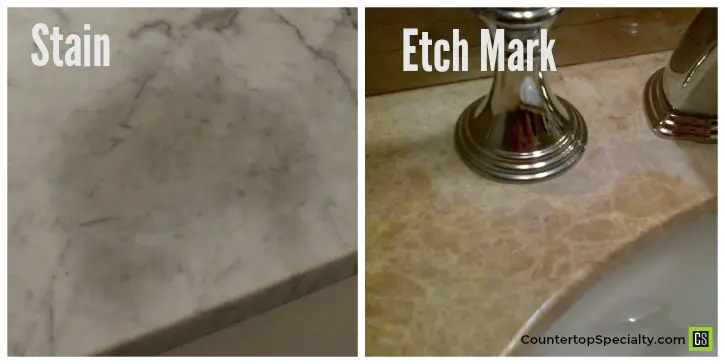
Stain: a spot darker than the marble color indicating a substance that has absorbed into the stone.
OR
Etching: a lighter spot, often white or chalky, and duller than the surrounding finish indicating chemical damage as a result of contact with an acidic substance like juice, coffee, alcohol, fruit, salad dressing, or a harsh cleaner.
If you have a stain (dark spot), you'll need to follow the step-by-step instructions in the Removing Marble Stains Manual. Regular cleaning methods won't get a stain out of stone.
Or you can use the "pre-made" marble stain remover.
Etch marks are a different story. You may need professional refinishing, but light etch marks can be removed on honed marble countertops with a DIY sanding method detailed in the Removing Etch Marks Manual.
For a couple etch marks here and there the DIY method is fine, but for the best results, it's best to hire a marble restoration pro to re-finish a honed countertop with many scattered etch marks.
Note that the method used for repairing etch marks does depend on the type of finish.
Polished marble etch marks can be repaired using the Marble Etch Remover. But no such product exists for use on honed marble. It's DIY or a professional for honed etch mark removal.
It is sometimes recommended to hone a polished marble in order to "solve" the etching problem, but re-finishing marble is expensive and this does nothing to stop etching.
Etch marks are less visible on honed marble than on polished marble, but honed marble etches exactly the same as a polished marble surface.
Again, sealers will help prevent stains, but not etch marks. Etch marks are physical damage to the marble itself so a sealer cannot prevent that in the same way that car wax cannot prevent scratches to your car paint.
Marble kitchen countertops are not recommended due to the problem with etching. You will absolutely get etch marks over and over.
The only way to prevent etching is to prevent contact with acids... nearly impossible in a kitchen, but using coasters, trivets and large cutting boards for all food prep will help.
Etching is not a big problem on marble bathroom countertops. It can occur, but exposure to damaging substances is so much less than on kitchen countertops.
Conclusion
Honed marble countertop cleaning and maintenance does present some mysteries, misconceptions, and frustrations, but all it takes is learning the key details presented above to wipe away the messy confusion and begin protecting and cleaning your marble with ease.
Comments for Honed Marble Countertop Cleaning
|
||
|
||
|
||
|
||
|
||
|
||
|
||
|
||
|
||
|
||
|
||
|
||
|
||
|
||
|
||
|
||
|
||



Excellent
Bathroom & Kitchen
Ideas
Source
2021