Which Granite Sealer To Use?
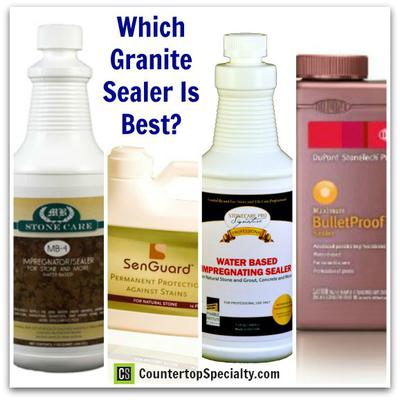

Marble & Granite Sealer Comparison
QUESTION:
I'm wanting to find the best granite sealer available, but not sure how to know.I was wondering... are there any reviews or studies ranking the performance of the different granite sealers?
I have looked at two in particular: MB Impregnator/Sealer for stone and Stonetech Bulletproof Stone Sealer. Any other suggestions?
ANSWER:
I understand your confusion. Choosing the best granite sealer can be challenging. Many sealers on the market will do an adequate job sealing granite countertops. But yes... there are significant differences.
We've used all the top brands, but have found a few that are more effective, durable, and cheaper sealers.
The following granite sealer review and discussion will provide the desired perspective, answers, and advice to help you confidently compare, evaluate, and decide which sealer to use.
Stone Sealer Evolution
"How long will it last" is typically the key question. That answer is not cut n' dried. Each sealer will have a range depending on certain variables.
The chemicals and ingredients used in stone sealers have evolved (and are still evolving), so they get better and more durable, but there are still plenty of low-grade sealers on the market.
A scientific sealer comparison would be great, but that's a tricky task.
A true comparative test would need several years with samples undergoing "normal" use and cleaning, or at least some type of an accelerated process that simulates years of use in a short time.
Either way... quite a project and may be of little use by the time completed as new or improved products hit the market.
Years ago Stonetech was cutting-edge, and I've recommended bulletproof in the past. It's a fluorocarbon aliphatic sealer that works by plugging up the pores (as most sealers do).
Fluorocarbon aliphatic sealers were once the very best class of sealers. Most of the recognized brands are now of this type (which is no longer the most advanced formulation).
Stonetech is still a decent, but average product similar to others in its class like Miracle 511, Marble Life, Stonecare International, Rock Doctor, Black Diamond, Weiman, Aqua Mix, etc.
MB Stone Sealer is far better... very good product, much more durable and longer-lasting than Stonetech and the rest of the "last generation" sealers.
None of the above are the best anymore, though. Sealer technology has advanced far beyond how "standard" sealers (like Stonetech, MB, 511) work.
Development of high-quality permanent stone sealers has left these behind.
Which Marble & Granite Sealer is Best?
The top product now for sealing granite & marble countertops (and other natural stone or porous surfaces) is the STAIN-PROOF Permanent DIY Granite Sealer.
STAIN-PROOF is currently the best granite sealer available.
Using nano-technology Stain-Proof employs the most advanced and durable sealer technology yet invented. It forms permanent bonds with the stone, which means... only one application necessary... no re-sealing!
Two or three coats may still be needed (depending on the porosity of your stone countertop) during that one application in order to effectively seal the granite, but then no resealing is necessary.
It can be applied to indoor or outdoor installations and to any porous
Note, we used to highly recommend SenGuard Sealer. Stain-Proof Sealer is the exact same formula and performance (made by the same company) but you get more volume of sealer at a cheaper price with Stain-Proof!
Obviously, Stain-Proof (and previously SenGuard) is a big step up from the "last generation" fluorocarbon aliphatic sealers that require re-application.
Stain-Proof Sealer is also super-easy to apply:
- Apply in small, manageable countertop sections
- Pour on a sufficient amount of sealer to cover the surface
- Spread the sealer into a thin film over the entire section of countertop
- Allow the granite sealer to dwell and absorb for 1-5 minutes, but...
- Do not let the sealer dry on the surface
- Remove all excess sealer and completely wipe the area clean and dry to remove all sealer residue
- Move onto the next section and repeat steps
The cost is less than Stain-Proof upfront, so it's a good choice if on a tight budget or when sealing a large floor.
However, it will need periodic re-application, so time / effort / cost catches up with you in the end.
All considered (total lifetime cost, performance, ease of application) STAIN-PROOF is easily the best value for all countertops and vanities.
Once you decide on which granite sealer to use, you can get answers to all your other sealing questions from our comprehensive sealing granite guide.
A couple other permanent sealers (Granite Shield, Permatreat) are also on the market, however, they are much more complicated to apply.
Granite Shield requires a multi-step application procedure and is more expensive than Senguard and Stain-Proof which are very simple to apply.
Permatreat can only be applied by a licensed technician (expensive).
For a complete explanation of sealer technology, different types of chemical formulations, how various sealers work, and how to apply sealers correctly then check out the All About Sealing Granite & Marble e-book.
It doesn't break down every brand, but it does thoroughly cover this topic, so consumers can get a detailed understanding of sealers.
Just remember that no sealer will work as well as designed without proper application. It's not a difficult job, but you must completely saturate the stone without letting the sealer dry on top.
Follow the directions carefully and you'll do fine.
First, be sure to perform the sealer application test to determine if you even need to seal the stone.
If you don't know... and many don't... some stones just don't need sealing and trying to apply one can cause problems with a hazy film.
Many dark granite colors (black, blue, green, brown) will not need sealing while white granite and lighter colors almost always require a sealer, but it's always best to directly test your specific countertop, tile, or any natural stone first.
Testing will eliminate any guessing and give you a definitive answer. If testing shows you should apply a sealer, then...
Stain-Proof Permanent Marble & Granite Sealer will provide the very best performance, durability, and value over all other sealers.
Comments for Which Granite Sealer To Use?
|
||
|
||
|
||
|
||
|
||
|
||
|
||



Excellent
Bathroom & Kitchen
Ideas
Source
2021