Outdoor Marble Table Dulled By Weather

QUESTION:
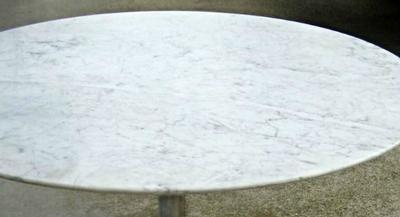
I have a Carrara marble bistro table that has been sitting outside on a sunny balcony for several years.The color has faded and the surface is dull and rough.
The original color was bright white, but now it is light gray. It has no obvious stains.
It has only ever been cleaned with water and a soft cloth.
Can you give advice on how to get it looking shiny again and care for it better in the future, preferably with natural or homemade materials? Thanks.
ANSWER:
Rain, wind, dust, and general weather has worn away the thin polished layer on the surface exposing the rough interior of the stone.Marble is polished by friction and abrasion with machines or hand tools kind of like sanding wood smooth... although it requires much more skill and knowledge than sanding wood.
Polishing marble brings out the color and better defines the details of the pattern.
So, a very thin layer on the surface is smooth and shiny. If that surface is worn away, then you see the rock in its natural state which is dull and less vibrant in color.
Professional re-polishing may be needed to get it to look like it did when you bought it. This depends on how worn and raw the surface is now.
Try a DIY restoration using the Etch remover polishing compound.
This product is excellent, but it is meant to restore what is essentially mild to moderate surface damage. If the surface is too rough, then a pro may be needed.
It's a lot cheaper than a pro, though, so could be worth a shot.
Or... just leave it the way it is. It is still beautiful with plenty of character... just different now.
Once restored the only sure way to keep the polish from wearing away again is to cover it when not in use.
Alternatively, and/or additionally you could apply a Topical Conditioning Polish that will coat the surface (temporarily as it will wear off in time) and provide a bit of protection from the elements.
And of course, clean with water only or a specially formulated Granite and Marble Cleaning spray.
Another option is to apply a color enhancing sealer if you like the look of the table when it is wet.
The color-enhancer will give it that "wet look" with a bit of a sheen (but not shiny) and a more saturated, darker color.
It will also help guard against staining, which the marble table will be much more susceptible to in its current rough state vs. polished marble which is less porous and absorbent.
Care of Outdoor Marble in Cold Climates
For outdoor marble in a cold and wet climate, you have the additional consideration of freeze and thaw
For marble tables and countertops, this is typically not a major problem as moisture inside the stone is able to evaporate from all sides.
You may consider applying a sealer to the top surface only of a table or countertop (allowing the bottom surface to breath well) to keep rainwater standing on the surface from absorbing, which will eliminate the major cause of cracking, etc.
Or cover the table / countertop during winter months.
Generally, sealing is only necessary when an absorbent stone will be consistently exposed to staining foods, drinks, products.
You will read/hear that "all natural stone should be sealed always" ... usually from a sealer company.
It's not necessarily bad advice, it's just not entirely true. Sometimes sealing is completely unnecessary and some stones just can't be sealed.
For tile laid on the ground or walls in wet areas like outdoor patios, pool decks, any exterior walls, (showers and baths too) sealing is not typically recommended because it's possible that the sealer may not allow the marble to breathe well enough and water will get trapped in the stone causing it to break down and fall apart over time. Or crack during freezing temperatures.
Sealer technology is getting better about letting the marble breath, but considering the risk of staining is so small in most wet environments, why risk it.
Outside, even if you risk some stains on tables or countertops from parties, bbq's, etc., weather (rain and sun) effectively wash out and bleach out stains pretty quick and relative to an indoor kitchen the exposure/stain risk is still much smaller.
So, again why bother or risk interfering with the stone's natural ability to handle the elements.
That's the thinking. It isn't necessarily a hard and fast rule. It's more a matter of assessing risk vs. reward considering the time and cost to apply.
Now, white marble can yellow when constantly exposed to water.
The reason is that white marble often has iron deposits within it. The iron gets exposed to water and rusts. The rusty water leaches through the marble to the surface causing it to yellow.
Sealing marble may help prevent this, but outdoors water can come up from under the stone as well, so you'd want to seal all sides of the tile.
Or better, go with a travertine or granite (which doesn't contain the iron deposits).
Sealing exterior patio and wall tile can be beneficial in some cases where efflorescence (minerals carried via groundwater through the tiles creating a powdery film on the tile) is occurring.
But generally speaking... it's best to leave marble and other natural stone unsealed outdoors. This is particularly true for ground and wall tile. For tables and countertops sealing will help prevent stains (and possibly freeze damage) without any real detriment to the stone.
Comments for Outdoor Marble Table Dulled By Weather
|
||
|
||



Excellent
Bathroom & Kitchen
Ideas
Source
2021